Wednesday, May 30, 2012

Royal Crowns remain kings of Canadian rockabilly

I sang on stage with the Bopcats at a show I snuck into 30 years ago, booked the Rock Angels into my high school two years later, have been drinking at Toronto's Horseshoe Tavern for almost a quarter century and was a regular at the club's biannual Living Elvis Karaoke nights for several years. So I've felt at least a small connection with singer, songwriter, drummer and bartender Teddy Fury for about two-thirds of my life, and a big part of that has been because of The Royal Crowns.

Teddy Fury
I confess that I've let my devotion slide a bit over the past couple of years, but I couldn't miss The Royal Crowns' launch weekend for the new Volume Three at Toronto's Dakota Tavern. I'd been listening to the album for a few weeks and its rockabilly sounds -- with hints of surf, jump blues, country and jazz slipped in -- charmed me as much as when I first heard the group's 32 Miles From Memphis debut a dozen years ago.

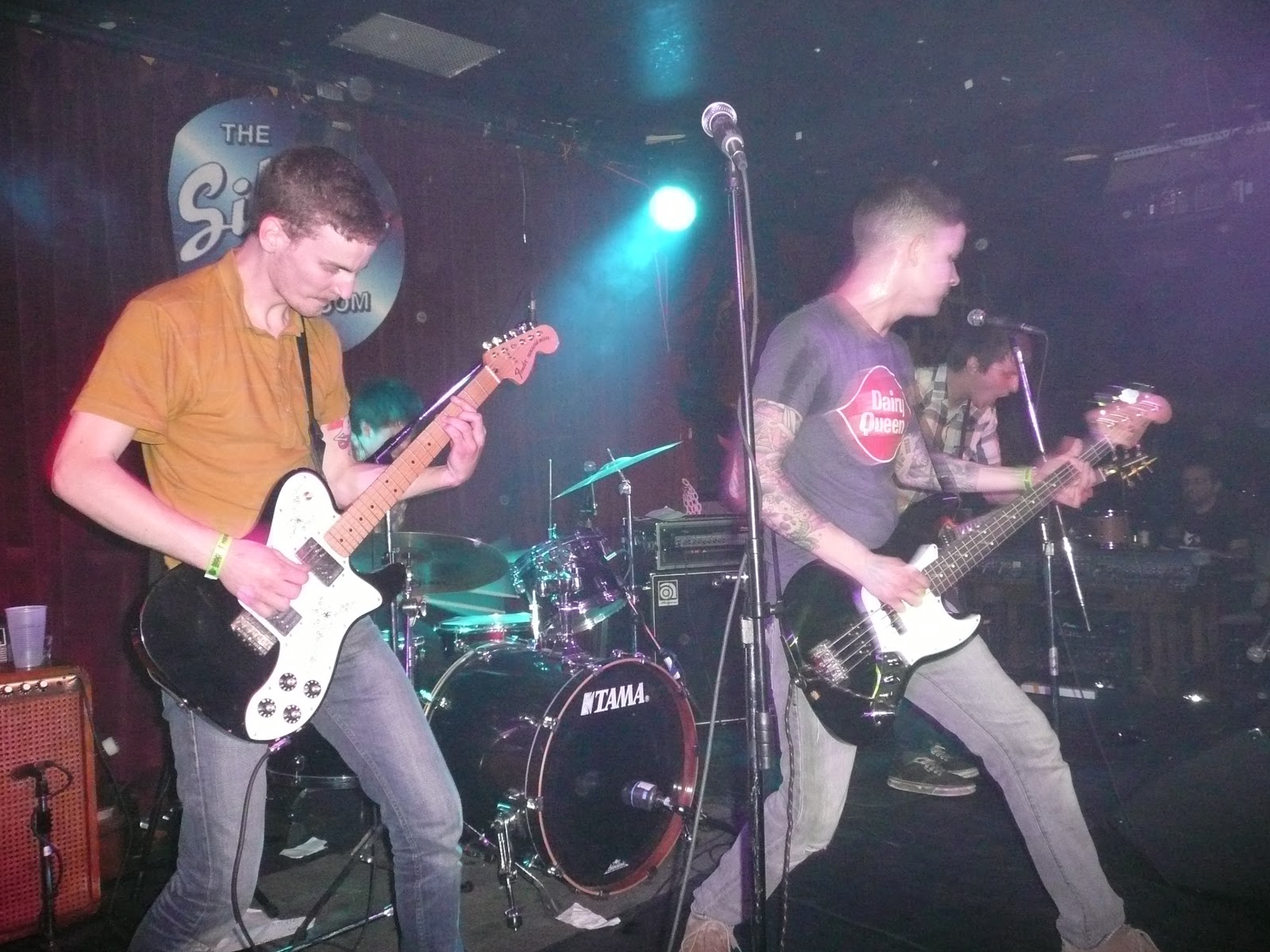
Founding members Fury and singer/songwriter/guitarist Danny Bartley are still the heart of The Royal Crowns, and upright bassist Jason Adams has fit in well since joining two years ago. They aren't doing anything revolutionary on Volume Three -- which was produced, recorded and mixed by John Critchley (13 Engines, Elliott Brood, Dan Mangan) at his Green Door Studios in Toronto's Parkdale neighbourhood -- but sometimes I'd just rather dance than overthrow a government anyway.

Danny Bartley
There's something to be said for all 15 songs, and they spring to life wonderfully on stage. Bartley sure knows his way around a Gretsch, while Fury and Adams provide a solid rhythm behind him.

The intimate Dakota was sold-out both nights last weekend, and I was happy to catch up with other longtime Royal Crowns fans and former members at Saturday night's show. There were also two brides-to-be (decked out in cowboy hats with veils) and their pals on hand for the first of the evening's two sets, and I talked to other younger patrons who had no idea who the Crowns were but heard that the Dakota was the place to be that night -- and they didn't leave disappointed.

The performance was obviously weighted heavily in favour of Volume Three material, and with standouts like "Butterball Baby," "Could It Be," "Please Stop," "3 Dollar Cologne" and my favourite, "Johnny's Sister," there was no reason to complain. But some older gems from 32 Miles From Memphis and 2005's After Dark -- most notably (for me at least) "Caveman Boogie" and "Greasy Corpse" -- made it a well-rounded night on the town that I look forward to repeating again soon.

Jason Adams
Volume Three was just released and, with the 2012 Polaris Music Prize contender cut-off date being May 31, I've just found the last addition to my initial ballot to reward the best Canadian album of the year.

Monday, May 21, 2012

Frank Turner and Joel Plaskett make great tag team

Frank Turner and Joel Plaskett Emergency, perhaps the best double bill that will hit Toronto this year, should have left no-one disappointed after Friday and Saturday night's performances. Even my friends who had people puking in the row in front of them at the Queen Elizabeth Theatre had a great time.

Turner filled England's Wembley Arena last month and is a bona fide star in his homeland while he continues to build his following around the world. His Toronto fan base is definitely growing and is undeniably loyal.

Frank Turner
Turner bounded on stage at 8:10 p.m. on Friday, admitting he didn't know what time it was since he'd just arrived from Australia to complete the last two nights of a lengthy world tour. He was on his own with his acoustic guitar and no band, but he has more than enough charisma on his own to compensate.

The set began with "I Knew Prufrock Before He Got Famous" and continued with 12 more songs from the breadth of much of his catalogue. People were singing and clapping along to most of them, including "Long Live The Queen" -- which I'm convinced is one of the best songs of this century.

Turner should be back at home in England by now and will soon start working on his next album. He previewed two songs that could be on it on Friday. The first was just finished that day and was getting its debut performance. It's still untitled, but is a relatively gentle song with lots of lyrics. The second newbie was "Wherefore Art Thou Gene Simmons?," a bittersweet yet humorous number about the KISS bassist's long, catalogued and photographed list of sexual conquests.

There were too many people in the theatre lobby during Turner's set, but I'm sure that he must have made believers out of a good portion of the Plaskett fans who might not have been familiar with him before. The man may have the worst tattoos in rock and roll, but he wears them proudly. I look forward to his Toronto return.
 
Joel Plaskett Emergency opened Canadian Music Fest with an invite-only gig high up in Toronto's CN Tower in March, and I thought that it was the most rocking and animated performance I'd seen from the group out of the dozen or more I've taken in over the years. There were certainly elements of that present on Friday night, but this was a much longer and varied set that also included a solo acoustic interlude where drummer Dave Marsh and bassist Chris Pennell got to take a break.

Joel Plaskett Emergency
Fans rushed the stage early in the set and almost all of the 1,200 people in the theatre were on their feet throughout the 110-minute performance. The loyalty and familiarity was evident with all of the singing along that went on, from "Tough Love" at the beginning to "Come On, Teacher" at the end.

I think I've probably thought of Plaskett as a songwriter first and foremost, even though I've never left one of his shows without having a good time. But this past weekend's shows reinforced that he's also a great guitarist and -- at age 37 and with seven studio albums to his credit since 1999 after the demise of former band Thrush Hermit, which released its first EP 19 years ago -- has become a complete entertainer who can totally charm a large audience.

Marsh and Pennell have combined with Plaskett to make the Emergency more muscular than it's ever been, and having "monkeys on a switch pedal" and a fedora-wearing bust of Wayne Newton on amplifiers near the back of the stage didn't hurt the entertainment value either.

Monkeys on a switch pedal
Both Turner and Plaskett knew that a lot of people would come to both the Friday and Saturday shows and they think enough of their fans that they changed their set lists so that if there was a favourite song you didn't hear one night, there was a good chance you probably would have heard it on the other night.

I was chastised for paying too much attention to my note-taking and photography on Friday night and not enough to the young hotties who were dancing beside and in front of me, but I'm pretty sure that the days of women half my age being interested in me are gone. Still, I elected to leave my tools of the trade at home on Saturday just in case I had one more kick in the can left in me. And what happened? I spent the night standing beside a young woman who I made cry about six years ago when she interned for me at ChartAttack.com and thought I was too tough on her performance assessment. So, needless to say, I didn't score that night either.

Joel Plaskett
But I attended a post-show party at the home of promoter Jeff Cohen (who was basking in his self-described "Bill Graham moment") and his hostess with the mostest wife Tara (my computer's auto-correct just changed mostest to moistest, but I thought I should change it back to avoid any potential gossiping). Turner didn't make it back to the house, but Plaskett and his crew and a lot of other friends did for hours of food, drinks, fellowship and falling into swimming pools. I took a traveller for my walk home and thought about how special the two nights I'd just experienced were until I arrived at my place at 5 a.m.

Here are the set lists from Turner and Plaskett's May 18 performances at Toronto's Queen Elizabeth Theatre:

Frank Turner
"I Knew Prufrock Before He Got Famous"
"Try This at Home"
"Peggy Sang the Blues"
"Wessex Boy"
"I Am Disappeared"
"Substitute"
New and still untitled song
"Long Live the Queen"
"If Ever I Stray"
"Wherefore Art Thou Gene Simmons"
"English Curse"
"I Still Believe"
"The Road"
"Photosynthesis"


Joel Plaskett
Joel Plaskett Emergency
"Tough Love"
"Waiting to be Discovered"
"Deny, Deny, Deny"
"You're Mine"
"Heartless, Heartless, Heartless"
"North Star"
"You Let Me Down"
"Harbour Boys"
"Beyond, Beyond, Beyond"
"Love This Town"
"Face of the Earth"
"Nowhere With You"
"Lightning Bolt"
"Work Out Fine" with interlude medley featuring Lee Dorsey's "Rain Rain (Go Away)," April Wine's "Oowatanite," The Rivieras' "California Sun," Manfred Mann's "Doo Wah Diddy," Sam Cooke's "Cupid" and Eagles' "New York Minute"
"Through and Through and Through"
"Maybe We Should Just Go Home" with interlude medley featuring Bo Diddley's "Who Do You Love?"
"Extraordinary"
"I'm Yours"
"Rollin', Rollin', Rollin'"
"Come On, Teacher"

Friday, May 11, 2012

Marley stirs it up

Today marks the 31st anniversary of Bob Marley's death. It was a huge loss back then and is still felt today. And although he's been the subject of several books and movies, a revealing new documentary titled Marley delves further and focuses on more people to create an enlightening and entertaining film that doesn't seem nearly as long as its 145 minutes.

Academy Award-winning director Kevin Macdonald (One Day In September, The Last King of Scotland) was thorough in his research and talked to about 60 people close to the man most responsible for popularizing reggae music around the world, including: wife Rita; children Ziggy and Cedella; other relatives; musicians Bunny Wailer, Jimmy Cliff, Lee "Scratch" Perry and Aston "Family Man" Barrett; Toronto-born girlfriend, former Miss World and mother of Damian Marley, Cindy Breakspeare; baby mother Pat Williams; Wailers artistic director Neville Garrick; Island Records founder Chris Blackwell; former Jamaican prime minister Edward Seaga; Marley's lawyer; Gabonese dictator Omar Bongo's daughter, who fell in love with Marley; the German nurse who looked after him in his final days of battling cancer; and people close to the man in his younger years, including former roommate Dudley Sibley.

While Marley and his music were known for bringing people together, the film reveals he wasn't very close to his children and his well-known womanizing (he fathered at least 11 children with at least seven different women) comes into even clearer focus. The man wasn't a saint.

I have a lot of Marley music in my collection and it, along with the messages contained in many of the man's songs, has prompted two pilgrimages to Jamaica to visit his birthplace in Nine Mile and his later home at 56 Hope Rd. in Kingston. But whether you're like me and have invested time and money in the man who's become an icon since his death at age 36 or are one of those people who know little more about him than you enjoy a song or two of his when you hear it at a restaurant, you'll come away with a much better understanding of Marley.

Marley screened at the Hot Docs Canadian International Documentary Festival last week and will play at Toronto's Bloor Hot Docs Cinema from May 18 to 31. You can watch a trailer for the film here.

Wednesday, May 09, 2012

The Queen of Versailles: Let them eat McNuggets

The 2008 global recession affected a lot of people in a variety of different ways, but one of the more intriguing "riches to rags" stories revolves around time-share king David Siegel and his former beauty queen wife, Mrs. Florida 1993 Jackie Siegel.

And director Lauren Greenfield tells the tale in a very entertaining way in The Queen of Versailles, a 100-minute film shot over three years that had three screenings at the Hot Docs Canadian International Documentary Festival last week.

Siegel became a billionaire as the founder, chief executive officer and sole owner of the biggest private time-share company in the world, Westgate Resorts. Convinced that their 26,000-square-foot Florida mansion isn't big enough for them, their eight children, numerous servants, a menagerie of pets (and a few stuffed dead ones), the Siegels designed and started building the largest house in the United States based on the Versailles palace outside of Paris that housed French royalty in the 17th and 18th centuries.

Plans for the 90,000-square-foot lakefront home on 10 acres near Orlando, Fla. include: a ballroom that can accommodate 500 people; a wine cellar with room for tastings and 20,000 bottles; a giant aquarium made by the folks behind Sea World; 13 bedrooms; a couple dozen bathrooms; 11 kitchens; a separate wing for the children; a stage; two movie theatres; a two-lane bowling alley; a video arcade; a roller-skating rink; an indoor pool; a fitness centre; a spa; staff quarters; a half-acre deck with three pools, a waterfall and a rock grotto; a boathouse; a guardhouse; a sandy beach; a formal garden; a full-size baseball field that doubles as a parking lot; and two tennis courts, one with stadium seating.

Yes, it's ridiculous.

Siegel seems to be on top of the world as he keeps opening more resorts through the first part of the 21st century, including his crown jewel in Las Vegas. He even takes credit for getting George W. Bush elected president in 2004, but won't divulge details because it may or may not have been done legally.

When the global financial crisis hits, however, credit dries up for both Westgate and the customers who were buying vacation time at its properties with money they often didn't have. Construction halts on Versailles when it's only half-finished, Westgate is forced to lay off thousands of employees as all of its non-core assets are put up for auction and sell for much less than market value. Bankers order Siegel to sell Versailles for $15 million after he's already sunk $75 million into it, and the 52-storey Planet Hollywood Towers by Westgate property in Vegas may be pushed into foreclosure.

The Siegels lay off 19 staff members from their "modest" existing house, leaving them with four nannies, a housekeeper, dog poop everywhere and a starved to death lizard that one son didn't know they owned. Jackie, who'd become accustomed to spending $1 million a year on personal shopping, is still a compulsive spender -- but her sprees are now at Wal-Mart and McDonald's as the family tries to cut back and save money.

David, 76, tells Greenfield that his marriage to Jackie, 46, is like having another child. He keeps her in the dark about Versailles going into foreclosure and the magnitude of Westgate's financial woes to the point where she says, "I'll have to watch the movie to find out what's going on in my life."

David grows distant from Jackie as he locks himself away to try and figure out a way to get out of his hole and avoid declaring bankruptcy, and it's at this point where it becomes clear that Jackie is no gold-digger and that she deeply loves her husband.

Siegel was forced to sell the Vegas tower last November and one of the final scenes of The Queen of Versailles shows the lights going out on the Westgate logo. The company is now about half its former size, but is making about $125 million in profits annually and David claims he'll be totally out of debt in three years. And yes, the Siegels have hung on to Versailles and plan to finish it.

But while Jackie attended the world premiere screening of The Queen of Versailles at the Sundance Film Festival earlier this year and signed autographs afterward, David has called the documentary a terrible portrayal of the family even though he hasn't seen it yet.

The Queen of Versailles is a film that should be seen. It's enjoyable viewing and for those with less than a firm grasp on economics, you can also consider it a Dummy's Guide to the Perils of Debt Financing.

Tuesday, May 08, 2012

The Final Member: Would you join this club?

Even the most clinical of documentaries is bound to elicit a few chuckles when the subject at hand is the search for a human penis to be the climactic exhibit in the world's only museum dedicated to the phallus. But The Final Member (which had three screenings at last week's Hot Docs Canadian International Documentary Festival) doesn't go for cheap and obvious laughs but instead strikes a pleasing balance among humour, poignancy and science.

The film by directors and Upper Canada College graduates Jonah Bekhor and Zach Math revolves around a quest by Sigurdur Hjartarson to acquire a human penis -- which would complete his collection of mammalian specimens -- for the Icelandic Phallogical Museum that he's built over four decades of collecting. Two men emerge as prime candidates: Páll Arason, an Icelandic adventurer who claims to be the country's most prolific lover, but who's nearing the end of the line at age 95; and Tom Mitchell, a patriotic American who calls his penis Elmo, has the stars and stripes tattooed on the head of it, dresses it in costumes and wants to create a comic book with Elmo as the superhero star.

One more thing about Mitchell: he wants to donate his penis to the museum while he's still alive.

Hjartarson would prefer Arason's penis to be the first since he's a national celebrity in Iceland, but age is taking its toll and it's starting to shrink. And in this case, size really does matter since Icelandic folklore stipulates that the "legal length" of a penis is five inches.

Arason went through a disastrous (and unintentionally hilarious) plaster casting of his penis years earlier, but it was destroyed almost as soon as it was created. Mitchell, meanwhile, has very specific plans for how he wants his penis presented once he has it removed. But Hjartarson finds him too demanding, and their phone and email relationship grows as frosty as a winter morning in Iceland.

With Arason lasting longer than a guy who swallowed a case of Viagra and Mitchell making Elmo into somewhat of a prima donna, Hjartarson comes to terms with his own failing health and mortality so he pledges his penis to the museum upon his death. The race, as odd as it seems, is on.

While Mitchell meets with doctors and consults with scientists about removing and preserving Elmo, he seems to be a lot of talk with little action. And when Arason finally passes away and carries through on his promise to donate his penis, it looks like he'll be the first human inductee into the museum. But the suspense rises when Hjartarson receives the member and has to examine it to see if it qualifies to appear on one of the museum's shelves.

Was 95-year-old Arason the legal length? I won't give the answer away since I'm sure you'll enjoy sitting through this 75-minute film enough to find out for yourself.

Thursday, May 03, 2012

Tchoupitoulas is easier to watch than pronounce

Tchoupitoulas tells the story of nine-year-old William and his two teenaged brothers from the portion of New Orleans on the west side of the Mississippi River called Algiers who take a short ferry ride across to the famous part of town and become immersed in the French Quarter for what turns out to be a very long night.

The sights and sounds are vivid as the boys and their dog Buttercup negotiate the streets and encounter some of the colourful characters that are hard to avoid in The Big Easy. I spent five days in New Orleans in November, which helped make so much of Tchoupitoulas seem familiar to me and added to my enjoyment of the film.

A theme of seeing the city and embracing it with child-like wonderment runs through much of the film, which has a pretty loose narrative owing to directors Bill and Turner Ross spending eight months and shooting hundreds of hours of footage in New Orleans before stumbling upon the boys and electing to make them their focus.

Aside from the city itself, William is the star of the show and there are brief and sometimes touching interludes in the film taken up by his amusing and unscripted monologues. And while the story arc of Tchoupitoulas (named after a major New Orleans street) is supposed to be limited to one night, a few continuity issues had me questioning its legitimacy.

The Ross brothers (who have potential as an acerbic comedy duo if they ever decide to leave the film business) fessed up in a post-screening interview that while about 80 per cent of the material featuring the boys in the film were shot on the initial evening, they got together twice more after that and used a few of those scenes. Other shots could have been taken at any point during the brothers' stay in the crescent city.

There's nothing groundbreaking about Tchoupitoulas, but it should be an enjoyable film for anyone thinking of visiting New Orleans or interested in rekindling memories of time spent there in the past.

Tchoupitoulas premiered at the South By Southwest Film Festival in Austin, Texas in March and will be shown again at Hot Docs at 10 p.m. on May 5 at TIFF Bell Lightbox 3.

Jeff depicts different sides of a serial killer

Jeff. The simple title could easily be affixed to a family comedy about a precocious eight-year-old and the innocent mischief he gets in with his pet guinea pig.

But Jeff, which played the Hot Docs Canadian International Documentary Festival in Toronto on Sunday night, is a film chronicling the heinous crimes of American serial killer Jeffrey Dahmer. It's early incarnation was as a fictional feature wherein director Chris James Thompson created scenes of things he imagined the Milwaukee, Wisc. resident did while not murdering, dismembering and snacking on young men. But when Thompson's friends yawned at an early rough cut screening, the young filmmaker knew he had to take a new approach.

You'll be glad he did. Some of those re-enactments (which feature no blood or gore at all) have been kept in to show how relatively mundane Dahmer's life often was. But news footage from the days following Dahmer's July 22, 1991 arrest reveals some of the sickening details of his crimes and how they impacted not just his victims and their families but an entire city.

It's three recently filmed interview subjects (okay, maybe just two of the three), however, that take Jeff to the next level up.

Pamela Bass lived across the hall from Dahmer in an apartment building in a poor black neighbourhood and uses the term "friendly but introverted" to describe him. "He was kind-hearted. He would share what he had with you," she goes on to say, before adding later on in the film that she became terrified that human remains could have been in a sandwich that she innocently accepted from him. Bass also reveals that she was offered $50 by a stranger in exchange for simply sitting on a couch that Dahmer had given her.

Police Detective Patrick Kennedy spent six weeks interrogating Dahmer after his arrest and probably came to know him as well as anyone ever had. While he became a minor celebrity for his role in bringing the killer to justice, the bushy moustached cop admits that being so close to such horrors took a toll on his personal life and played a role in ending his marriage.

The least compelling of the interviewees is Milwaukee medical examiner Jeffrey Jentzen, whose clinical detachment makes his recollections seem less compelling than his two counterparts -- even when he describes opening Dahmer's fridge and finding little else but a human head and condiments inside it.

Thompson and Kennedy were on hand to answer audience questions after the Hot Docs screening I saw (the film's first official screening was in March at the South By Southwest Film Festival in Austin, Texas), and their insights helped make the film come to life even more. You probably won't have the same opportunity to interact with the two men, but I still recommend the film to anyone interested in seeing how the banal and the horrifying can often jarringly co-exist with each other.

Jeff's final Hot Docs appearance will be at 9:45 p.m. on May 4 at TIFF Bell Lightbox 2.

Wednesday, May 02, 2012

Shut Up and Play the Hits

LCD Soundsystem was a group on the periphery of my awareness. I liked the songs I heard, and loved the video for "Drunk Girls," but I never acquired an album and didn't see the band perform.

So I was surprised to find out just how popular the James Murphy-fronted electro-dance-rock act had become over the course of three albums when the singer announced that the group was disbanding last year and would play its final show on April 2 at New York City's Madison Square Garden. The storied arena sold out instantly, and it's that final performance and the moments leading up to it and after it that are the focus of Shut Up and Play the Hits, a documentary directed by Will Lovelace and Dylan Southern that played at the Hot Docs Canadian International Documentary Festival on Tuesday night.

The film goes back and forth between scenes of Chuck Klosterman interviewing Murphy and footage from the concert. The sound and cinematography are both excellent and really bring the LCD Soundsystem live experience to life, and backstage scenes with special guests Arcade Fire enhance the aura of this being a special event.

Murphy was in his mid-thirties by the time LCD Soundsystem released its self-titled debut album in 2005, and he cites the aging effects that touring had on him as a major reason for dissolving the group at the height of its fame when he was 41. Later, when asked what the band's biggest failure is, he replies that he's not sure yet but thinks that it might be ending it.

Murphy comes across as a thoughtful and likeable person, but he shows his vulnerability towards the end of the film when he breaks down and cries when he's alone with LCD Soundsystem's equipment and instruments following the final show.

Tears were also streaming off some fans' faces at that last concert. And while LCD Soundsystem's break-up meant little to me when it happened, Shut Up and Play the Hits successfully conveys the band's impact and helped me understand why its demise was a major event for many.

And playing Soft Cell's "Say Hello Wave Goodbye" over the closing credits wraps things up perfectly.

You can watch the trailer for Shut Up and Play the Hits here. You can see the entire film at Toronto's TIFF Bell Lightbox 1 at 9:30 p.m. on May 3 and at TIFF Bell Lightbox 2 at 6:30 p.m. on May 5. The documentary will receive a wider release this summer.

Tuesday, May 01, 2012

She Said Boom: The Story of Fifth Column

I first became familiar with Fifth Column in the mid-'80s when I started playing the thought-provoking song "The Fairview Mall Story" from the band's 1985 To Sir With Hate debut album on my campus radio program. 

I then discovered the "Boy/Girl" seven-inch and gave quite a few spins to the group's swan song 36C album that came out in 1994 (and I'm playing it again as I write this). I saw Fifth Column a couple of times toward the end, but didn't follow the all-female outfit closely enough to consider myself an avid fan.

So She Said Boom: The Story of Fifth Column both brought back memories and filled me in on a lot when I saw the film's world premiere as part of the Hot Docs Canadian International Documentary Festival this past Friday.

The 64-minute film by director Kevin Hegge features recent interviews with group constants Caroline Azar and G.B. Jones, as well as some of the  many other musicians who passed through the often fractious lineup over the years. Jones was quite involved in Toronto's independent film scene, shot Super 8 movies and became friends with controversial gay filmmaker Bruce LaBruce, who acted as a go-go dancer for Fifth Column in the early days.

LaBruce offers his thoughts on Fifth Column, as do two people who were fans from a bigger distance: Bikini Kill and Le Tigre founder Kathleen Hanna; and homo-core punk pioneer Vaginal Davis.

Hanna helped launch a zine called riot grrrl in 1991, and it spawned a label that was affixed to numerous aggressive female rock bands of that decade -- including Hole, L7, Sleater-Kinney, 7 Year Bitch and Bratmobile. These groups owed an obvious debt to Fifth Column, which mixed punk, psychedelic and other rock forms and adapted a take no prisoners attitude on stage. The group garnered feminist and lesbian followings because of all this, but I was aware of that.

What I didn't know, just like with films, was how involved the members of Fifth Column were with the burgeoning zine scene of the '80s that Davis was also part of and helped create the underground queercore movement. These other forms of expression helped enlarge the group's musical audience and, although Fifth Column never received the credit or attention it deserved, Melody Maker made 36C's "All Women Are Bitches: Repeat!" its single of the week when it came out.

Vintage photos and film and video footage of Fifth Column add a lot to the modern interviews and help put pieces of the puzzle together -- especially for people who may have heard the band's name but never saw it perform. They also add to the appreciation of how  ahead of its time Fifth Column was.

You don't have to own a Fifth Column album to enjoy She Said Boom because, as the film made me realize, these women were always about much more than music.

She Said Boom: The Story of Fifth Column plays tonight (May 1) at 9 p.m. at Toronto's Cumberland Four (theatre two) and at 7 p.m. on May 4 at the Fox Theatre as part of Hot Docs.

Thursday, April 26, 2012

Finnish punk rock with a twist

Pertti Kurikka's Name Day
Pertti Kurikka’s Name Day formed just three years ago, and the four-member Finnish punk band already has a film about it in Canadian theatres.

It's not because the group is set to become the next Clash or Green Day, but because of its interesting story. Singer Kari Aalto, guitarist Pertti Kurikka, bassist Sami Helle and the youngster of the band, 27-year-old drummer Toni Valitalo, all have developmental disabilities.

They have temper tantrums, threaten to quit the group and fill rooms with expletives. But so do a lot of bands.
Pertti Kurikka

Few, however, have a guitarist who claims he has a poisonous vest that has killed 400 people or a grey-haired singer who's about to get engaged but still doesn't know how babies are made. But Aalto's very aware that he hates pedicures when he sings:

"Why doesn't anybody understand that they always force me/To hang out with these bastards and go for a pedicure/Fuckin' pedicurists/They all suck big time/They just take care of your feet/They don't understand/Why the hell do pedicurists exist?/That's something I never figured out/They force me/They force me/It sucks that they force me to get a pedicure/I don't understand."

Kari Aalto
Of course, all the words are sung in Finnish, as is all the spoken dialogue in the 85-minute The Punk Syndrome which makes its North American premiere on April 28 and receives two more screenings as part of the Hot Docs festival. But the subtitles keep your attention as you wait to hear what lyrics will come next, perhaps something along these lines: "It was a Sunday/I went to church/I had coffee/I took a dump."

But the plight of what the band members have faced in their lives comes to the forefront in other songs, and shows that the rebelliousness and anti-authoritarianism that the Sex Pistols spit out at the world 35 years ago can still resonate even with people who aren't fully functional on their own in society. "Decision-Makers Are Cheaters" is a prime example:

"Decision-makers lock people up in closed rooms/But we don't wanna be in those rooms/Nobody looks after us/Nobody comes to visit us/What's going to happen to us orphans in those rooms?/Decision-makers cheat/Cheaters make decisions/They don't give a shit about us disabled."
Sami Helle

Saying that the singing and playing is far from polished would be an understatement, but Pertti Kurikka’s Name Day has developed a bit of a cult following after playing shows in its homeland and Germany and releasing three EPs. I don't know whether people who go to the band's shows genuinely like the music or they're being patronizing, but the joy you see in the four members' faces when they leave the stage can't leave you feeling anything but good for them.

“The film tells about Pertti Kurikka’s Name Day … so it’s about one retard who sings punk and three retards who play punk," says Aalto. "You should watch it and think about whether you should hate disabled people or love and respect them.”

Toni Valitalo
The characters aren't necessarily loveable, and you may sometimes find yourself laughing at them, but in the end The Punk Syndrome enables you to establish the respect they're looking for.

Watch the trailer here.

Friday, March 30, 2012

Beau's All Natural Brewing makes a new fan

I'm not all that big on Beau's All Natural Brewing Company's flagship beer, Lug Tread Lagered Ale. And I wasn't particularly enamoured with its Night Marzen Oktoberfest Lager when I tried it last fall.

But I was still excited when I found out about Beaulo, a Beau's total takeover of one of Toronto's top beer bars, Bar Volo, on Thursday evening. The problem was, a lot of other people were excited, too. That, combined with Bar Volo's small size and a much stricter adherence to legal fire code capacities than most music venues I find myself in, meant I waited two-and-a-half hours to get in despite arriving 15 minutes before the 7 p.m. start time.

The temperature dropped and I wasn't dressed as warmly as I should have been, but I read a newspaper and met some nice people who were also shivering in the cold. I normally don't stand in lines for more than a few minutes, but I had no other plans, so I stuck it out as bottles and casks were tantalizingly close a mere metre away over the patio fence.

By the time I got in, some of the 27 different beers that were available at the beginning of the night were gone. I was most disappointed not to try the May Contain Traces of My Nuts Peanut Butter Stout (an exclusive Beaulo one-off), but was also shut out from the Smokin' Banana Peel Smoked Hefeweizen, Collabrrrewator Coffee Doppelbock, Dunkel Buck Dunkel Weizenbock and Doble de Accion Agave Pale Ale, which was aged with tequila-soaked oak chips.

Tokens were three dollars each, and 10-ounce plastic cups of beer cost either two or three tokens. I bought nine tokens and made my way to the main bar.

First up on my hit list was Weiss O'Lantern Pumpkinweiss, a white beer brewed with pumpkin that had a dark orange colour, slightly spicy bouquet and a lively flavour. The 4.6-per cent alcohol brew may be the best pumpkin beer I've ever had, and I look forward to its return next fall.

Doublewide Double IPA was created by my friend Brad Clifford, the 2011 Great Canadian Homebrew Competition winner, but brewed at Beau's. It was available in both cask and keg, and I went for the cask as I always do when given a choice.

I'm happy to report that this eight-per cent alcohol India Pale Ale was well worth the third token. The dark amber brew had a spicy, hoppy aroma and was very nicely hopped without being excessive, and had just the right amount of bitterness. It uses a variety of malts and hops, is delicious and goes down surprisingly easy for such a high alcohol beer. Unfortunately, the last of it was consumed at Beaulo. It will be missed.

I stayed in the IPA family and dropped two tokens on a cup of Beaver River I.P.Eh? from the cask. It was a similar colour to the Doublewide, but had a milder bouquet. There was a nice blend of fruitiness and caramel in the flavour combined with a well-balanced hoppiness. This 5.6-per cent alcohol seasonal IPA is available now in 600-millilitre bottles in select Liquor Control Board of Ontario stores and on tap at some bars and restaurants.

I wanted to end my night with something dark and went with the two-token Ryes Above Rye Porter. The bar was out of the cask version, so I went with the keg. It was quite dark, had a decent head and had a semi-sweet bouquet and chocolatey flavour that wasn't too heavy on the rye, which I was happy about. I would have appreciated a little more body to it and, while it was my least favourite of the evening, it was still pleasing.

Was it worth waiting in line for two-and-a-half hours? Probably not. But I was happy with what I tasted and Beau's now has a convert who's eagerly awaiting the release of its 5.9-per cent alcohol Patio Saison in the next week or two. I always appreciate a good saison.

Monday, March 26, 2012

The Wedding Present end Canadian Music Fest on a high

Sunday is generally a relatively quiet night during Canadian Music Fest, with only a small fraction of the participating venues featuring acts, and the best choice of them all seemed to be the Horseshoe Tavern.

I arrived in time to hear one song by Pinky Piglets, and that was enough. But the singer walked up to me after her performance and said "Thank you," so the female Japanese quartet gets points for politeness -- and for being the shortest band in the festival.
The Jet Age

The Jet Age was a late addition to the bill, and I confess to not knowing anything about the Washington, D.C. trio. One song had cowbell and of course my immediate response upon hearing it was: "More cowbell." Singer/guitarist Eric Tischler is a skilled player, and certain members of the audience seemed to appreciate the indie rock band, but no songs grabbed me during the 35-minute set.

The Wedding Present is a veteran Leeds, England outfit wherein singer/guitarist David Gedge has been the only constant. It's a band that I've always felt that I should like more than I do, but I've only seen it once before years ago, so I thought I should give it another shot.
The Wedding Present

The set opened with "Back a Bit … Stop" from the group's new Valentina album, and then went back 25 years for "My Favourite Dress." Gedge has always been recognized for strumming very fast chords and being a bit of a wordsmith, and that was further illustrated through a performance of "Quick, Before It Melts" from Cinerama, the band Gedge led while The Wedding Present was on hiatus from 1998 to 2003.

I'd estimate a crowd of about 300 in attendance, and the bar remained virtually empty during The Wedding Present's performance, so obviously there were dedicated followers on hand and not just folks out to extend their weekend with several Sunday night drinks. The first part of the set ended about 30 minutes in with "Perfect Blue," and then came the section which was the main draw for many people.

Seamonsters came out in 1991 and was The Wedding Present's third album -- and the first full-length recorded for the group by Steve Albini (Nirvana, Pixies). Many feel it remains the band's best album, though some might lobby for 1989's Bizarro or 1987's George Best, which was named after the legendary Northern Irish soccer player who I became friends with that year when he used to buy me drinks almost every night as a regular at the London, England pub I bartended at that summer.

But this portion of the show was all about performing Seamonsters in its entirety, and the 10 one-word-titled songs really showed Gedge and his latest bandmates at their post-punk best. "Rotterdam," "Lovenest," "Corduroy" and "Heather" stood out as my favourites, though there weren't really any weak ones in the bunch.

The Wedding Present doesn't do encores, so at the conclusion of Seamonsters Gedge announced that the band would perform two more songs to end the night before leaving the stage for a final time. The first number was "Kansas" and closer "Don't Talk, Just Kiss" got people dancing and wanting more just before it was time to head out the door.

I thought that Canadian Music Fest would be a bit of a downer after spending the previous week in Austin, Texas for the South By Southwest Music Festival, but there were enough good acts and performances to keep me  entertained over five straight nights.

I've decided to pass on JunoFest later this week in Ottawa, however, since I'm a bit festivalled out at this point.

Sunday, March 25, 2012

Three great bands made me happy on CMF's Saturday

Saturday's Canadian Music Fest began for me when I arrived at the El Mocambo for the Aussie BBQ at 4 p.m., which gave me just enough time to eat a free sausage on white bread with barbecue sauce and caramelized onions before Oh Mercy began playing a few minutes later.
Oh Mercy

The first song reminded me of a cross between Wilco and Velvet Underground, and the band didn't top it during the rest of its 25-minute set. The lead singer is a lefty who plays a right-handed guitar upside down and has a good vocal range, and the rest of the band plays guitar-driven but rhythmic indie rock. It was okay.

I went upstairs to hear a couple of songs from Melbourne duo Big Scary, but it didn't do much for me either so I returned downstairs for DZ Deathrays. The Melbourne guitar and drums duo was noisy and not particularly entertaining, so I left.

The Screwed was playing three sets of classic punk rock covers at Graffiti's, but unfortunately the band was taking a break when I dropped in, so I carried on to the Music Nova Scotia party at The Rivoli.

I talked to some people who I probably haven't spoken to since this party last year and had two bowls of delicious chowder and some sauteed scallops before singer/songwriter Mo Kenney began her solo acoustic set. Joel Plaskett is producing her upcoming record and she has talents as both a singer and a whistler, but I preferred her final number -- a cover of David Bowie's "Five Years" -- over her originals.

Ben Caplan, a bushy bearded artist with a deep voice and delivery that was occasionally reminiscent of Tom Waits, delivered a solo acoustic performance and engaging between-song banter. I most enjoyed his final song, "Stranger," which had an eastern European folk element.

I'd never heard of Ria Mae, but she played a hollow body electric guitar and had another woman named Margot singing back-up and showed me a lot of talent. She writes depressing songs, but displayed a good sense of humour and humility between them and after her set when I spoke to her at the bar.

Jon Janes is The Mountains & The Trees, and the Newfoundland native who now lives in Nova Scotia sang and played electric guitar -- most impressively when he used a bow on his final song.
Mike O'Neill

Former Inbreds member Mike O'Neill took the stage on his own with an electric guitar at 8 p.m. and played a longer set, which included my favourite Inbreds song, "Any Sense of Time." He also performed material from his new solo album, Wild Lines, including "Don't Forget To Breathe," and older songs like "Camera Shy." He also performed "Andy," which Neko Case covered on her 2001 Canadian Amp EP. O'Neill writes good songs.

Ron Sexsmith, Damhnait Doyle, The Pursuit of Happiness' Moe Berg and Sloan's Chris Murphy and Patrick Pentland were among the non-performing performers at the party over the almost four hours that I was there. Murphy was standing behind me during O'Neill's set and, when he saw me taking notes, he suggested including "Lose the moustache" in my review.
Chains of Love

It was time to head a wee bit west from The Rivoli for the Horseshoe and the band I was most looking forward to: Chains of Love. The Vancouver sextet is fronted by Nathalia Pizzaro and singer/guitarist Rebecca Marie Law Gray, and they both downed a shot before beginning their impressive set. If you took a Phil Spector-produced '60s girl group and a band from the Nuggets compilations of garage rock from that era and then added a dose of soul, you'd get Chains of Love. But you don't have to, since Chains of Love already and thankfully exists. In addition to loving their music, Pizzaro and Law Gray seem like the kind of women that would be fun to party with, so I hope they return to Toronto soon.
Katalina Kicks

I'd never been to Underground Garage before, and was surprised to find that I had to go up stairs to get there. England's Katalina Kicks was supposed to start at 9:45 p.m., so I thought I'd catch its last few songs, but things were delayed until 10:10, which allowed me to order a Strongbow for myself and a friend who asked to remain nameless but had previously seen the band in its homeland and liked it.

The trio is equally influenced by '60s rock by The Who and The Kinks, '70s punk and 21st century alternative rock. It also has a Strummerville connection, which further piqued my interest. I liked it, but it seems to be missing something that would take it to the next level.

The rain and wind had let up a bit so I decided to take a bit of a hike to C'est What, where I figured I could find a seat, enjoy a few pints of craft beer (which I hadn't had all festival, unless you count the Blanche de Chambly at The Hideout on Friday night) and hear some good music.
French Wives

I'd seen the last two songs of Scottish band French Wives at the Easy Tiger Patio in Austin, Texas during last week's South By Southwest Music Festival, and liked them enough to see a full set. I wasn't disappointed. The single "Numbers" ranks among the best songs I've heard this year, with Siobhan Anderson's violin adding an element of class to the indie pop number and singer/guitarist Stuart Dougan's understandable lyric delivery which belies his Glaswegian roots. It went down well with a Granite Hopping Mad from the cask.

The excellent set also included "Halloween," which was a hit in the group's homeland three years ago, "Sleep Tight," and the closing number, "Younger."  There's an epic quality to the music, but it stays away from the pretension that can creep into the repertoire of lesser acts who aspire to have that word used in concert with its work. French Wives' debut album, Dream of the In Between, is scheduled to be released in May.

I ordered a cask-conditioned 8.5-per-cent alcohol Wellington Imperial Stout, and I enjoyed the nutty chocolate flavour and the punch it packed as I sat down at a table in front of the stage while Nash set up.
Nash

I wrote the bio for Nash and his debut solo album, The Death of Reason, last year. But I'd only spoken to the multi-talented artist via phone and email and had never seen him perform, so I introduced myself before the set. Nash has a colourful history and he sang, played bass, guitar, keyboards, programming, omnichord and glockenspiel -— pretty much everything but drums —- on The Death of Reason, which he also recorded, engineered and produced. He played both guitar and keyboards for this performance and the backing by another keyboardist and guitarist, along with bass and drums, added a more muscular quality to the pop music that wasn't as evident on the record.

I appreciated the rawness of "Broken Down Satellites," "Sad Robot Harmonies" was excellent, a trumpet came out for "In a State of Mind" and the set ended with "Suit Up." I'm always pleased when people I work with and like turn out to be even better than I originally expected when I entered the relationship, and Nash certainly proved himself with this performance.

I headed back out into the elements and ducked my head into the Horseshoe to say hello to a few friends before moving on for The Stanfields' 2 a.m. set at The Hideout. I've become a big fan of this Halifax Celtic rock group over the past few years and was happy to see that the place was packed and people were dancing in front of the stage. Band manager Ian McKinnon, who I'd spoken to at the Music Nova Scotia party earlier in the evening, was also pleased by the raucous performance and the rabid response.

The Stanfields have started recording a new album that I'm looking forward to. But in the meantime, I recommend you see the band and listen to its Vanguard of the Young and Reckless debut album.

Saturday, March 24, 2012

Canadian Music Fest Friday: Good but not great

I'd liked St. Catharines, Ont. street punk band The Lucky Ones when it opened for Stiff Little Fingers at Lee's Palace last August, so I was looking forward to seeing the quartet on Friday night at the recently renovated Bovine Sex Club.
The Lucky Ones

There weren't a lot of people in the club when The Lucky Ones kicked off the 9 p.m. slot with "No Fear, More Beer," the opening track from the recently released The Booze Sessions. There seemed to be a slightly harder edge to the band than what I recalled, but that could just be my faulty memory. "Ten Pints Goodlookin', "Punks R Drunk" and "Raise A Glass" give you a good idea of what many of the songs are about. I was hoping for more, but I'd give The Lucky Ones another shot.

I was cutting through Kensington Market when I heard a band playing Elvis Costello's "Pump It Up." As I walked toward the open door of the small venue, a street person charged past me and went inside, grabbed a tambourine and started what I guess she considered dancing. "I'll go get the water," she exclaimed repeatedly as management escorted her outside after the song and I continued on my way.

I arrived at the El Mocambo early for Apache Relay's 10:30 p.m. set and was very pleasantly surprised that D.A. Foods was serving free mini pulled pork sandwiches and hamburgers. That eliminated the need to buy dinner.

I didn't know much about Apache Relay, but had received a couple of recommendations, so I found myself near the stage as the Nashville, Tenn. sextet walked on to it. The group plays loud indie rock, but with mandolin and fiddle added into the mix. Lots of movement and energy permeated through visceral numbers like "State Trooper," "Set Me Free" and "Watering Hole." I didn't dislike it, but I wasn't knocked out, so I left mid-set for the Silver Dollar.
Last Year's Men

Promoter Dan Burke's latest garage rock find is Last Year's Men, a young quartet from Chapel Hill, N.C. that's doing a three-night residency at the Silver Dollar during Canadian Music Fest. I got a Black Lips vibe from "Paralyzed" and the other songs in the short set, including the more '60s-influenced "Spilled." Singer/guitarist Ben Carr kept breaking strings and, during one break in the action, bassist Montgomery recited a list of things he's thankful for, which included "Molson M, tobacco, Tim Horton's and Dairy Queen."

Carr jumped into the crowd and did a headstand to end the abbreviated set, which I enjoyed but expected more from. But a friend who saw the band on Thursday night said it was better then and that I should think about giving it another chance, so there's a possibility I'll be back at the Silver Dollar tonight to do just that.

I just caught one song from Chains of Love back at the El Mocambo, but heard enough that I liked that I'll try to see the band at the Horseshoe tonight.
Johnny Dowd

Johnny Dowd was rocking his Stratocaster and spinning his gothic yarns along with a drummer and keyboardist when I entered Comfort Zone. It's been a few years since I've seen the soon-to-be 64-year-old, but he seemed to be exhibiting more energy than I remember from the past. He's aging gracefully and craggily, just as he should. The surprisingly young and appreciative crowd picked up on it, and some were even dancing.

Dowd's blend of alt.country and experimental bluesy rock is hard to pigeonhole, but he's received comparisons to Tom Waits and Nick Cave. He was using a music stand to read the lyrics, which came in handy on "Hot Pants" and the disturbing "Betty" from his forthcoming No Regrets album that includes 13 songs that all bear the names of women.

Comfort Zone rivals Mod Club and Revival for worst beer selection of any music club in Toronto. I was reduced to ordering a Molson M, perhaps because of Montgomery being thankful for it less than an hour earlier and the fact that the other choices weren't any more appealing.
Thee Attacks

I headed back down to Queen Street for Danish band Thee Attacks, who I missed out on seeing in Austin, Texas last week but heard rave reviews of. The quartet played an 11-song set of straight-ahead rock-and-roll for its first Canadian performance that was largely comprised of material from its debut album with a few new ones from the impending follow-up.

Frontman Jimmy Attack wore tight leather pants and stalked the stage when he wasn't playing guitar. He stood and sat on monitors, pulled down a film screen to briefly hide the band from view and got down into the audience. He knows all the microphone and tambourine tricks and is a pure entertainer who I'm sure has no problem getting laid after shows, while guitarist Terry Attack actually does attack his instrument with abandon like Pete Townshend 45 years ago. He's good enough that Jimmy doesn't need to play rhythm, as the group loses a bit of momentum when he's not prowling around unencumbered.

Thee Attacks' songs aren't as consistently good as the showmanship, but there's a lot of potential with this young band, which recorded its debut album with producer Liam Watson (The White Stripes' Elephant). And I usually like bands that put Thee instead of The in front of their names despite the pretension of it.

I saw people in wheelchairs who appeared to have long-term disabilities at three different clubs, and it was great to see them out enjoying themselves.

I thought I'd drop by the Horseshoe to see who was hanging out and, when I arrived, was told that Dan Mangan was the surprise 2 a.m. guest. As much as I think he's one of the nicest guys around and I wish him all the success in the world, I elected not to fight through the large crowd and was content to stand at the back of the bar talking to friends while he played before moving to the front bar for one more pint before calling it a night.